Funding & Financial Administration


Agile Policy Development for Climate Funding
Interactive modeling of funding guidelines to avoid logical gaps and inconsistencies. Simulation of funding allocation during the drafting stage to ensure maximum practicality. Significantly faster creation of legally compliant regulations through visual structuring. e
Question
The development of government funding guidelines for urban greening—including for the purpose of climate protection—is usually a lengthy, text-heavy process.
- Complexity: It is difficult to predict how logical conditions (Who is eligible? What is the funding rate?) will play out in practice.
- Inconsistencies: Drafts based purely on text carry the risk of logical gaps or contradictory criteria.
- Lack of practical testing: Often, it is only after publication that it becomes clear whether the funding amounts are distributed sensibly or whether the guidelines fail to meet actual needs.
Solution
Instead of months of back-and-forth revisions in text documents, we opted for an agile, model-based approach.
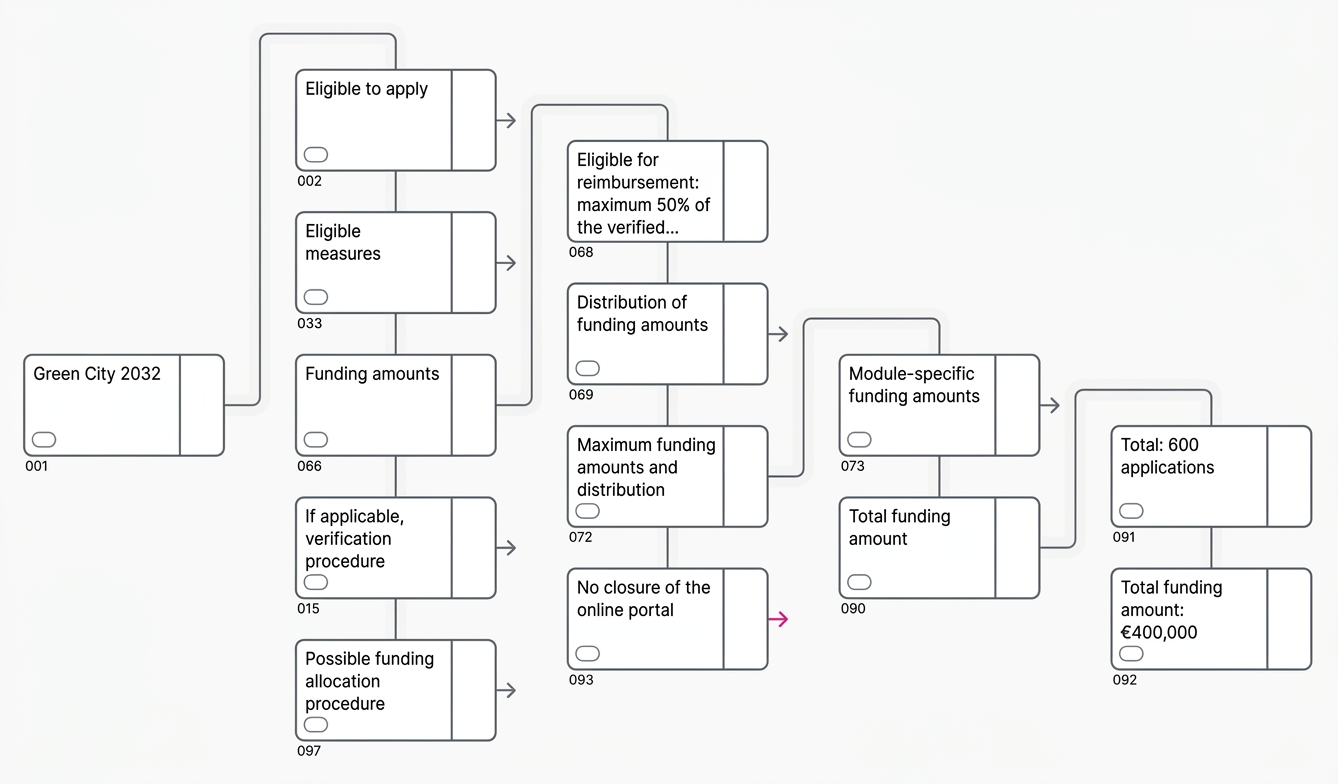
- Visualization via Rulemap: An initial two-page sketch of the funding concept was directly converted into a digital Rulemap (using ARUM).
- Interactive workshop mode: In just two hours, the guideline was worked out in detail by the team. The visual structure made it possible to immediately incorporate “second levels” and detailed conditions.
- Simulation & Optimization: Test runs were conducted even before finalization to verify the practicality of the logic.
- Automated Export: The finished logic was converted directly into a potential written guideline via Mura.
Outcome
The use of the rulemap served as a “logical framework” for the entire funding initiative.
- Accelerated process: The policy was developed significantly faster than through traditional, purely written methods.
- Higher quality: Inconsistencies and logical errors were immediately identified and corrected through visualization before they became legally binding.
- Data-driven allocation: Simulations ensured, even at the draft stage, that funding amounts were allocated in a mathematically sound and targeted manner.
- Digital foundation: The structuring laid the groundwork for a natural-language set of rules that can be implemented digitally without any detours.