Permitting & Review Procedures


AI-powered decision support for faster building permits
97% automation of formal building permit reviews through an innovative “law-as-code” approach. Saves several hours per application through intelligent, rule-based decision-making logic. A scalable standard for faster approvals nationwide and digital building administration.
Question
Building permits are among the most complex administrative processes in Germany. They are characterized by extensive regulations and long processing times.
- High complexity: The interplay between building regulations and urban planning law requires an extremely in-depth technical review.
- Legacy analog processes: Manual review steps and media discontinuities result in procedures lasting several months.
- Pressure on skilled personnel: Building authorities are under enormous time pressure to implement the digital building application (OZG) comprehensively and efficiently.
Solution
Together with the Thuringian Ministry of Digital Affairs and Infrastructure (TMDI), we have developed a modular verification architecture based on Rule AI.
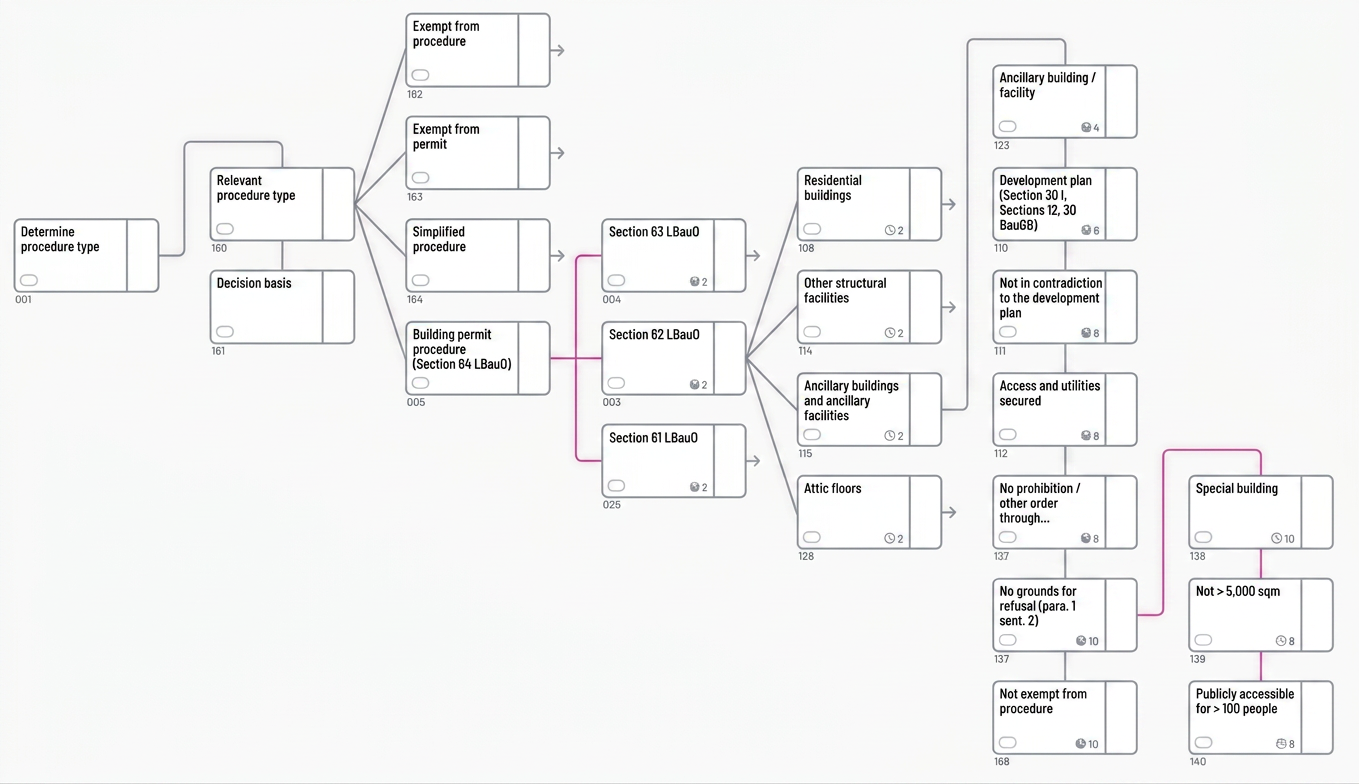
- Law-as-Code & No-Code: Natural-language laws were converted into over 500 machine-readable verification nodes. Modeling is performed directly by subject matter experts without any programming.
- Automated Application Review: A module handles the review of procedure type, completeness, and formal legality. Application data is automatically extracted and validated.
- Human-in-the-Loop: Complex urban planning considerations combine automated suggestions with targeted intervention options for case workers.
Outcome
The project sets new standards for the nationwide scaling of digital administrative processes.
- Extreme level of automation: Approximately 97% of the review steps in the first module are automated; only 3% require manual interaction.
- Significant time savings: Tests in pilot counties show the potential to save several hours per building permit application.
- Scientifically sound: Supported by the Technical University of Munich and Schmalkalden University of Applied Sciences, the solution can be fully integrated into existing EfA process environments.
- Cross-state synergy: Through cooperation with Mecklenburg-Western Pomerania, the system is designed as a scalable standard for all of Germany.